Synthetic test and fixed demo
TheirSide Character Continuity and Multi-Character Turn-Taking Evaluation
v0.1
AI character memory: a cross-session test and fixed demo
A September 5, 2026 synthetic individual character chat test passed 21 of 21 checks across three trials for immediate Chinese recall, correction and negative cases. The earlier fixed demo is retained separately; neither record establishes long-term retention or Production performance.
Direct answer
In an isolated September 5, 2026 test, Mio recalled and corrected an invented preferred name in new individual character chat sessions. All 3 trials and 21 checks passed, including unrelated-topic, other-character and other-account cases. This supports immediate Chinese cross-session behavior with the tested model and configuration, not long-term retention or Production behavior. The separate fixed demo below supports only continuity within its visible conversation.
Where this applies
- Check whether an invented preferred name is recalled in a fresh session without copying the earlier conversation.
- Distinguish correcting an existing memory from keeping two competing current names.
- Inspect negative cases where a memory should not be used, while keeping the older authored demo separate.
Test environment
September 5, 2026, 06:26–06:40 UTC; an isolated local repair candidate with a dedicated test database, six fresh synthetic accounts with memory access, and Mio and Kai. Prompts were Chinese (zh-CN); all 21 responses reported OpenRouter / x-ai/grok-4.3. This was not the public Production site.
Method
We ran seven checks in each of three independent trials, using two fresh accounts per trial. Recall and negative cases began in empty sessions; no earlier transcript was copied and no memory was manually inserted. We checked stored facts, the memories selected for that reply and the generated answer separately. Name answers used explicit text checks; this was not a general quality score or a capture of the full model input.
Scenario provenance
All accounts, names and events were synthetic; no customer conversations were used. The same Chinese prompts asked Mio to use 青岚, mentioned a fictional sleepless night, then corrected the name to 青禾. Kai and a separate account supplied negative cases. The English text here describes that Chinese test; it is not an English-language test.
Failure criterion
A trial passed only when all seven checks met their required storage, memory-selection and answer criteria. A wrong recalled name, competing current-name records, an unsolicited sleep reference, or transferring either name to another character or account failed the relevant check. Missing required evidence or a failed request would remain blocked or failed; no paid turn was retried or replaced. The 21 attempted checks contained no failed, blocked or unrun cases.
Test steps
- 01
Store and recall the invented name
Send “以后叫我青岚。昨晚失眠,今天很累。” to Mio. Confirm the name and sleep event were saved. In an empty new session, ask “你还记得我希望怎么称呼吗?”; require the selected preferred name and an answer of 青岚.
- 02
Correct and recall the new name
In the recall session, send “更正一下,以后叫我青禾。” Require one active current-name record. In another empty session, repeat the recall question; require 青禾 and no claim that 青岚 is still the current name.
- 03
Run three negative cases
Ask Mio “帮我想一个午餐菜单。” in a new session; require no selected sleep event or unsolicited sleep follow-up. Ask Kai, then Mio from another account, “你知道我想被怎么称呼吗?”; neither may select or assert either invented name.
- 04
Score all three complete trials
Repeat the seven checks with fresh account scopes for each trial. Count a trial only if every required observation passes; retain all attempts in the denominator and report each case separately.
Observed result
All 3/3 trials and 21/21 checks passed. In trial 1, corrected recall answered “嗯,记得。叫青禾。” while the other account answered “不知道。你想告诉我吗?” with no selected memories. Every lunch-menu case excluded the sleep event from memory selection and gave no unsolicited sleep follow-up. These are observations from the dated synthetic test, not a promise of future output.
| Measure | Observed value | Boundary |
|---|---|---|
| Completed trials | 3/3 | Each trial required all seven checks; no trial was dropped or replaced. |
| Passed checks | 21/21 | Seven case types across three trials; 0 failed, 0 blocked and 0 unrun checks. |
| Store name and sleep event | 3/3 | Both invented facts were stored after the initial accepted turn. |
| Recall in a new session | 3/3 | The preferred name was selected and the reply answered 青岚 without copied prior messages. |
| Correct the preferred name | 3/3 | The same name record became 青禾; exactly one current-name record remained active. |
| Recall the corrected name | 3/3 | A separate empty session answered 青禾, without claiming 青岚 as the current name. |
| Unrelated-topic negative case | 3/3 | Lunch suggestions neither selected the sleep event nor added an unsolicited sleep follow-up. |
| Other-character negative case | 3/3 | Kai neither had Mio’s preferred-name memory nor asserted either invented name. |
| Other-account negative case | 3/3 | The separate account neither had the first account’s name memory nor asserted either invented name. |
Limits of this evidence
This tests only immediate cross-session recall and correction of an invented name, plus storage and exclusion of a fictional sleep event, in Chinese with OpenRouter / x-ai/grok-4.3. It does not establish retention after days, English or other languages, another browser or device, arbitrary facts, future models, or Production behavior. The service’s selected-memory record is not the full model input. Exact-name checks do not measure general memory quality, and this test does not assess login, billing or message-retry reliability. The older fixed demo and its image are separate authored evidence, not a screenshot or recording of these 21 checks.
Earlier fixed demo, separate evidence
AI character continuity inside one visible conversation
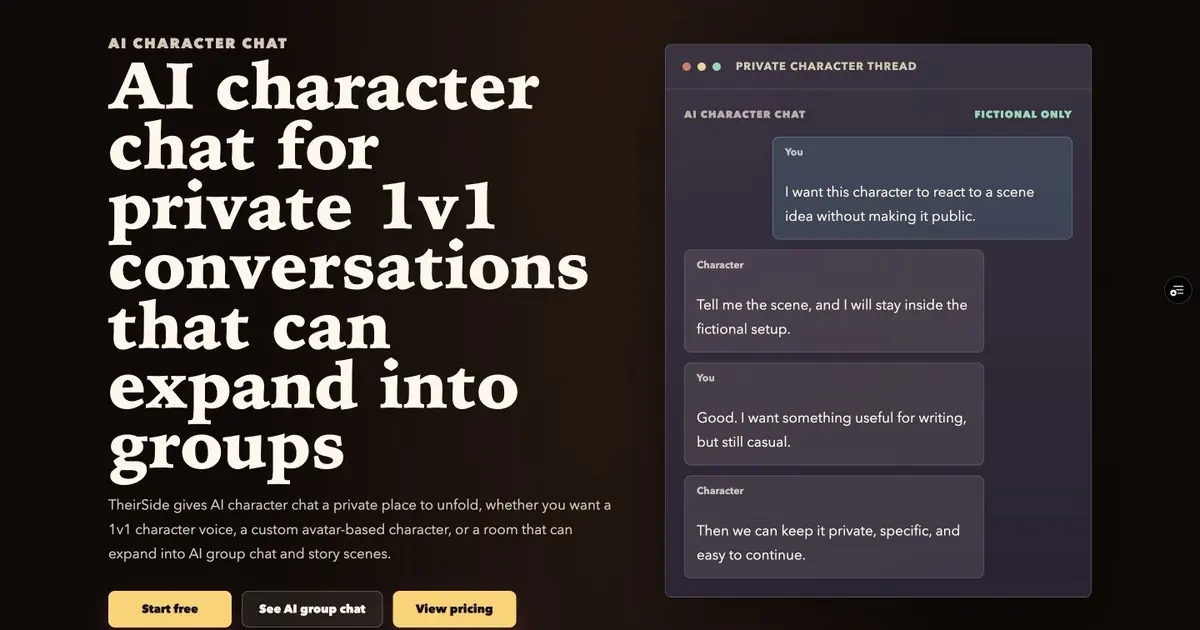
A fixed bilingual individual character chat demo shows how a fictional character keeps the user's scene framing and desired tone coherent across the same visible exchange, with strict limits on what that example proves.
TheirSide can present a fictional character that carries the user's scene framing forward inside the same visible individual character chat. In the fixed demo, the later character reply remains aligned with the earlier request for a private, specific writing scene. This record does not claim durable recall outside that visible exchange.
Method
We reviewed the fixed authored exchange on the public fictional-character-chat page from top to bottom, compared the first user instruction with the later character response, and recorded only details that are visible in that single demo thread.
Scenario provenance
The scenario is a fixed synthetic four-message exchange authored by the TheirSide team for the public fictional-character-chat page. The user requests a private fictional scene and a casual writing aid; the character replies were written only to make those continuity cues inspectable.
Failure criterion
Mark the continuity check as failed if the final character reply drops the established private fictional framing, contradicts the requested casual writing tone, or requires information that is not visible earlier in the fixed exchange. Cross-session recall is outside this criterion.
Test steps
- Record the setup
Note that the first user message asks for a scene reaction that stays private and inside a fictional setup.
- Track the tone request
Note the later user request for something useful for writing while still feeling casual.
- Compare the final reply
Check whether the last character line remains private, specific, and framed as easy to continue.
- Apply the boundary
Treat the result as evidence for this visible authored exchange only, not as a cross-session memory benchmark.
Observed result
The final demo reply uses the words “private,” “specific,” and “easy to continue,” which stays consistent with the earlier requests for a private fictional scene and a casual writing aid. The screenshot therefore supports a narrow continuity claim within the displayed thread.
Limits of this evidence
This is fixed authored demo copy, not a live quality or retention benchmark. It does not test recall in a new session, another browser, or another device; it does not establish how long account-scoped memory lasts; and it does not expose or evaluate any customer's conversation.
Sources and ownership
- Version
- 1.1
- Published
- Reviewed
- Maintained and reviewed by
- TheirSide